Chiappa 92 Take-Down, By Taylor & Co?

I've always felt that the locking system of the Winchester 92 was the most eloquent of all the American lever actions. The twin vertical locking lugs that bridge the cuts in the receiver and the bolt are lightweight yet exceptionally strong and simple. John Browning’s creativity and brilliance continues to show more than 130 years later.

Take a moment to examine the locking system of the model 1892. The vertical locking bars are subjected to a shearing force, but that force is directed across the longer front to rear aspect of the bars, and this allows the bars to be relatively thin but yet extraordinarily strong. And by combining the action of the lifter with the twin locking lugs, Browning was able to make extremely efficient use of the parts needed in two inter-related operations (cartridge feeding and locking).

Take the efficient 92 action and mate it with a handgun caliber cartridge, and you get a strong, lightweight, firearm that is reliable, accurate, useful, and handy.

The carbine length barrel extracts the maximum possible potential energy out of a handgun cartridge. The rifle configuration with multiple points of contact with the operator (two hands on the gun, stock on the shoulder and cheek on the stock) make for a solid shooting platform. There’s a lot of speed, accuracy, capacity and power there to be exploited at ranges under 150 yards with the ability to stretch that a little if needed.

A modern Red Dot sight combines speed with precision that is possible with iron sights but probably faster under demanding conditions (low light, moving targets, etc.)

A mechanical action that doesn’t rely on the power of the cartridge to operate the action gives the operator a lot of options to tailor the cartridge to the job. If the bullet will exit the barrel, the cartridge will feed in the action and the cartridge isn’t over pressure – you can make it work.

The take-down action allows for very compact storage and transport; even in a pack if needed. And the ability to share ammunition between a handgun and a long gun is an advantage that men have recognized for as long as handguns and long guns have existed.

There’s a lot more to a short model 92 take down chambered in a handgun cartridge than initially meets the eye.

The take down feature also allows for easily cleaning from the breach. To me that is the most important reason to pay extra for the takedown model.
 
My understanding of the deal was that he was challenged by the president of Winchester to come up with a new gin to replace the 73 and to compete with a "new" Marlin offering. Browning said he could do it in a month, almost as a bet(?), but since he chose to scale down the 86 for the job, he was done and delivered a working prototype in two weeks. He was compensated quite well for that, for the day, and it went on to be quite popular, chambered in then-current RIFLE cartridges of the day (for which "pistols" were subsequently chambered also).

I can't personally see a fella doing much better off than to have as a "one gun" a 92 in 44-40 for all his homestead firearms needs.

I wish I still had my 2011 Rossi 92 in 357. At 5#, was THE handiest repeating long-arm I've owned. I would hesitate to say that the 92 is "better" than Marlin's 94, because I cannot say objectively that this is true. I have deep respect for both, but I just like the 92 more. This one is a bit on the weighty side, but I'm trying to suck that up for the other features and the quality of the thing in general. It's making me want another in traditional form, maybe even a 44, but that is really contradictory to the point of having this one, which offers me for functionality and practicality in deference to aesthetics.
I have a Winchester/Miroku Model 1892 in 357/38SPL. It likes the Lee 125gr RF, as well. It has a twist rate of 1 in 18.25”. Jeff, what twist rate does your Taylor/Chiappa ‘92 have?
 
The take down feature also allows for easily cleaning from the breach. To me that is the most important reason to pay extra for the takedown model.

That's an excellent point. I actually swabbed the bore when I took it apart, just because it was from the breech. I'd read how difficult it was to take them apart and put back together, so I wondered how practical the feature was. When I took it apart, I believed it, because I had to lay the receiver/stock in an open wood vise with some padding and get both hands on the fore-end/barrel to break it loose.

But, when I put it back together, it went together with comparative ease with one hand on each half, but it was not "loose" by any means and it stopped dead at the correct alignment. Examining the threads, bot internal and external, they are done VERY well and are "VERY clean."

I'd read conflicting reports on the muzzle thread and rifling twist and was given the impression that the twist rate was rather slow, so the first time I peeped down the bore, I was surprised. It LOOKS much faster than I'd been lead to believe. After the initial cleaning, I ran a really tight patch through and came up with ABOUT 1:16" or maybe 1:18" (or so) and was satisfied with that, so I did not go to further effort to nail it down exactly. The 1:30" twist in the Rossi left 200 grain bullets going fully sideways through a target at 15 yards.

The LEE 125RF shot well in the Rossi, the Marlin, Contender Carbine, a couple Handi-Rifles and now this one. That bullet has been consistently dependable as a test-bullet to see if it's me or the gun when I'm having a bad-target-day.
 
My Miroku/Win 92 repro's barrel has a 1-26" twist rate. It stabilizes all of my flatnose castings up to the 300 grain gas checked Lee monsters that really have no business in any 6# 44 Magnum carbine. My 265 grain FNGC loping along at 1900 FPS or so imparts all the recoil needed to rivet my attention. Those 300s remind me of the Hornady 350s in my now-departed Ruger #1 x 45/70......one notch too much push-back.
 
Are those bullets in the loaded rounds powder coated? If so, what powder? I like it!
No, that's tumble-lube. In real life they look like bare alloy. You have to smell them to tell if they are lubed.
The bullet is the MP358-165RF with the flat-nose/"slid" pins in the mould. I'm starting to really like this bullet as a general-purpose 357 loads.
 
UPDATE:
Hit a snag yesterday showing my son in law the 92. When I asked him to tilt the rifle 90 degrees and eject the case into his hand, so we didn't have to drive somewhere to pick them up, I forgot to mention to tilt it back up to close the action. Things got jammed up. The take-down feature helped a lot with that, but I did have to remove the lever, locking lugs and bolt, so I decided to g ahead and fix the NASA-issue ejector spring.

I found a suitable spring from my stock and replaced it. Empties fly up, over and out and land within two feet f MY two feet. Even ejects dummies loaded with 187 grain WFNs, so it's plenty vigorous without being a big pain in the butt.

One thing I loved bout the old Mausers - "selective ejection." Flop 'em onto the bench while shooting targets or launch them clear when you need them out of the way.

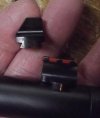
Ordered a normal front sight from Skinner to replace the seasonally appropriate glowing pumpkin on the top of the issue sight. Also ordered one of their neat, fabric (Nylon, Gortex?) folding, take-down cases for it and a rear sight spare parts kit. Oh, if you get a gun with a Skinner sight, don't assume the W/E set screws are tight. THAT made a BIG difference in POIs not walking on me.

Next time I take it apart, I'm going to address a little hard-to-reach hitch on loading the 187 grain WFNs and MP 358-165 RFs. Shot some PC's through it today and the PC was very useful in providing "witness marks" as to where the (literal) hang-up is.

My new prescription lets me see the front sight clearly now, so I'm skipping both the Red Dot or scope and might just take the pic-rail/peep off and mount a Williams back where it belongs.

Fingers crossed the normal lever shows up by Christmas.

AND,... I am going to need to take about an inch off the Sasquatch butt stock and maybe find a hard "plastic" butt plate, because it's way too long for me and sticks to my shirt when handling it. Otherwise, I'm more tickled with this little rifle every time I handle or shoot it. I feel more and more that this could make me feel very comfortable and a "one-gun" for my needs. I've played the field, had my fun. Just wanting to settle in with something I really like, enjoy and which serves my needs.
 
After circling the drain in the Cleveland distribution center for three days, leaving once and returning in two hours, USPS finally delivered some stuff I ordered from Skinner today.

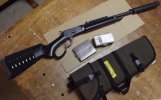
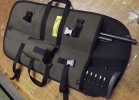
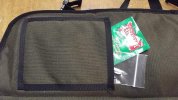
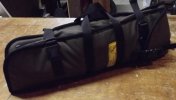
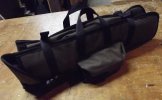
I wanted to get Andy's folding take-down case just because it's so cool. Since I have so few mouths (chambers) to feed these days, I can do something like that. I am duly impressed with the construction, materials, design and workmanship on this case. Very pleased. It has a nice lining, decent padding and is well thought out. Everything in the picture fit into it without a shoe-horn.

The whole rifle is pretty long with the can installed - about like a typical long-action bolt-rifle with a 24" barrel.
Plus a box of fifty 357 cartridges and an 18-roiund "ammo wallet." There are loops inside for maybe a cleaning rod?
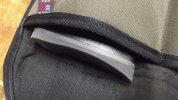
There's a pocket for a suppressor and one for the obligatory paperwork as well.

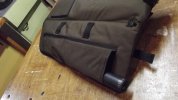
This is the 20" case and the butt doesn't quite fit in there, but I need to take off more than what is sticking out, so no big deal. The oversized loop just BARELY fits with the ridiculous wrap on it. Hopefully the regular lever comes soon.
I like that it's not camo, black or OD. In th epics, it LOOKS like OD, but it's dark brown. You CAN get black or OD if you want.
I need to find a thread protector of some kind for the external interrupted threads on the barrel, like maybe a pipe-thread protector. Couldn't find one that size (.805") in my cache of "stupid stuff I've saved"
DSCF5468 (Copy).JPGDSCF5471 (Copy).JPGDSCF5472 (Copy).JPGDSCF5473 (Copy).JPGDSCF5474 (Copy).JPGDSCF5475 (Copy).JPGDSCF5476 (Copy).JPG
 
Last edited:
I also ordered a normal front sight to replace whatever they call this new fad of glowing gobs. To retain the orange "light pipe," someone melted the ends with a hot knife to "rivet" the thing in place. BRILLIANT!! Except that the melted end is misshapen and overly large. I guess it won't fall out though. I got a pretty good looking replacement from Andy for $25 and grabbed a rear sight spare parts kit - one of every screw in his set-screw-locking sights and the two Allen wrenches for only $5!
DSCF5469 (Copy).JPGDSCF5470 (Copy).JPG
 
I am going to need to take about an inch off the Sasquatch butt stock and maybe find a hard "plastic" butt plate, because it's way too long for me and sticks to my shirt when handling it.
There are two basic schools of thought when it comes to the butt plate on a rifle or shotgun.

The soft, sticky, grabby, maybe slightly recoil absorbing type.

And the slick, smooth, hard, won’t-hang-up, type.

I’ve run both types on rifles, shotguns and carbines and I don’t know if there’s a perfect answer, but I think my fallback would be a hard, slick but slightly checkered one.

A soft, sort of “grabby” recoil pad is great when you have all the time in the world to set up for a shot. You can pull it into your shoulder and it’s ok if it hangs up a little because you have time to adjust.

But for fast shooting, you need a slick plate that will not grab clothing and get in the way. Almost every old field-use shotgun I grew up with had a hard plastic or even steel butt plate.

And the material that case is made of is probably Cordura Nylon. BTW, that is a cool case. I can see why you wanted it.
 
What is the material the stocks are made of? Is that gun available with walnut stocks?
Yes. There are numerous variations and I think it changes year to year. Between Chiappa and Taylor & Co (rebranded Chiappa), there are strictly traditional models as well. I believe the current version of the Wildlands" (this one) is walnut.

This one is beech,... maybe sycamore, but I can't see much of it below the paint. It's a black "splatter-paint" and is just fine for me, but I don't mind looking at walnut one bit.

Do a general internet search on "Chiappa 92" and you'll get tons of so-called "reviews" which are nothing but regurgitated sales blather, but you'll also find some decent write-ups and lots of people retailing them.
 
There are two basic schools of thought when it comes to the butt plate on a rifle or shotgun.

The soft, sticky, grabby, maybe slightly recoil absorbing type.

And the slick, smooth, hard, won’t-hang-up, type.

I’ve run both types on rifles, shotguns and carbines and I don’t know if there’s a perfect answer, but I think my fallback would be a hard, slick but slightly checkered one.

A soft, sort of “grabby” recoil pad is great when you have all the time in the world to set up for a shot. You can pull it into your shoulder and it’s ok if it hangs up a little because you have time to adjust.

But for fast shooting, you need a slick plate that will not grab clothing and get in the way. Almost every old field-use shotgun I grew up with had a hard plastic or even steel butt plate.

And the material that case is made of is probably Cordura Nylon. BTW, that is a cool case. I can see why you wanted it.

Yeah, something in between, but hard to find. The trend toward really thick and gooey pads... Pain in the butt. This is a 7# 357 Mag. You could drive nails into the butt stock, clip them off with side-cutters, sharpen them and shoot the thing without drawing blood! OK, maybe a stretch, but you don't need a 1"+ thick, gooey pad for this.